Hearing supplements
Tinnitus Supplements: What Research Says and What to Check
Tinnitus supplements are vitamins, minerals, herbs or amino acids sold to quiet ringing in the ears. The research is thin: Cochrane reviews of ginkgo and zinc found little or no benefit, and the 2026 US guideline says clinicians should not recommend supplements for persistent, bothersome tinnitus. Quietum Plus is one such capsule product, with no amounts printed.
Written by the Quietum Plus label deskUpdated
01Definition
What is a tinnitus supplement?
A tinnitus supplement is a pill, capsule or powder sold with the promise of calming ringing, buzzing or hissing in the ears.
Tinnitus is the sense of a sound with no outside source. Surveys put it at 10 to 25% of adults (NIDCD, Tinnitus). Because it is common and hard to live with, it attracts a lot of product claims.
Most tinnitus supplements are blends. They pair a few vitamins or minerals with plant extracts and, sometimes, amino acids. Their labels rarely say which ingredient is meant to do what.
The NIDCD notes that no cure exists and that no medicine for tinnitus is approved by the FDA. It adds that supplements advertised for it have not been proven to work (NIDCD, Tinnitus).
02Terms
What are hearing supplements and ear health supplements?
They are the same kind of product under different names: dietary supplements marketed for hearing, the inner ear or ear comfort.
"Hearing supplement", "ear health supplement" and "inner ear health supplement" are marketing labels, not medical categories. Under US law they are dietary supplements. They may describe how an ingredient affects normal function, but they may not claim to treat or prevent a disease (FDA, Information for Consumers on Supplements).
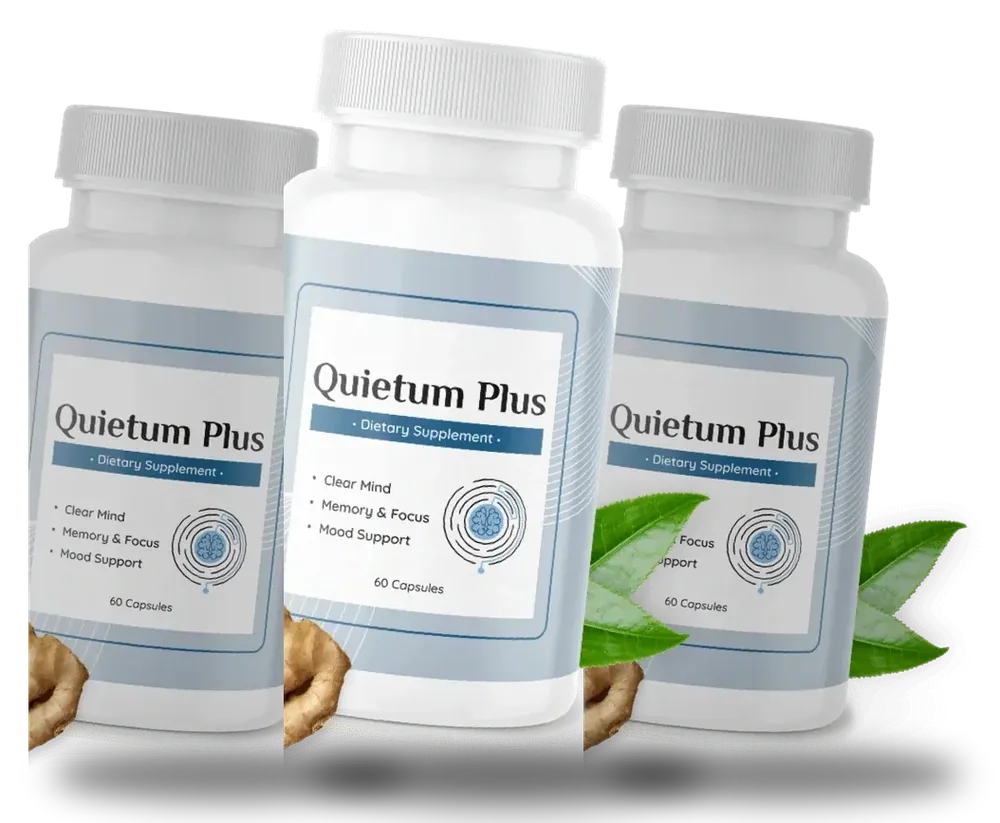
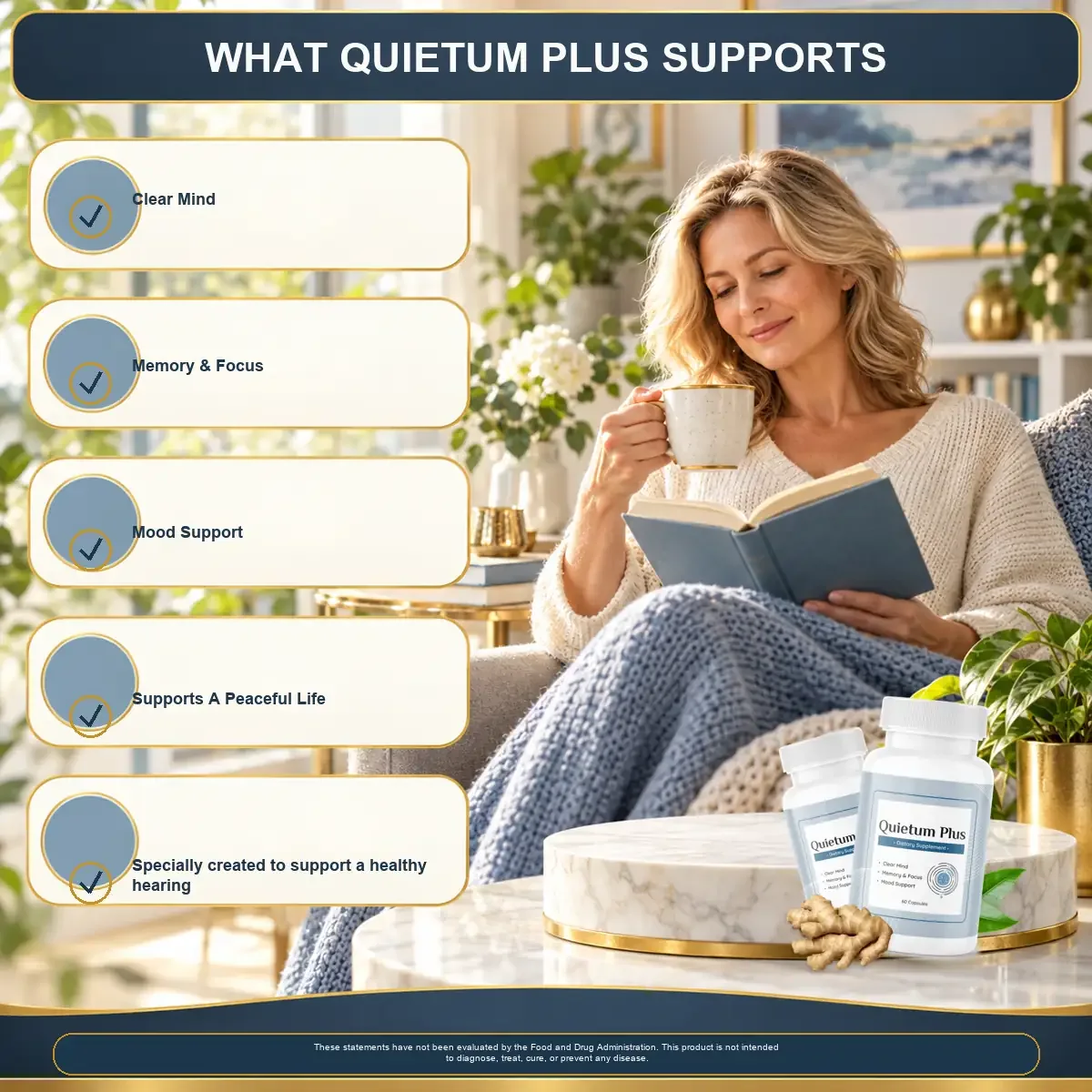
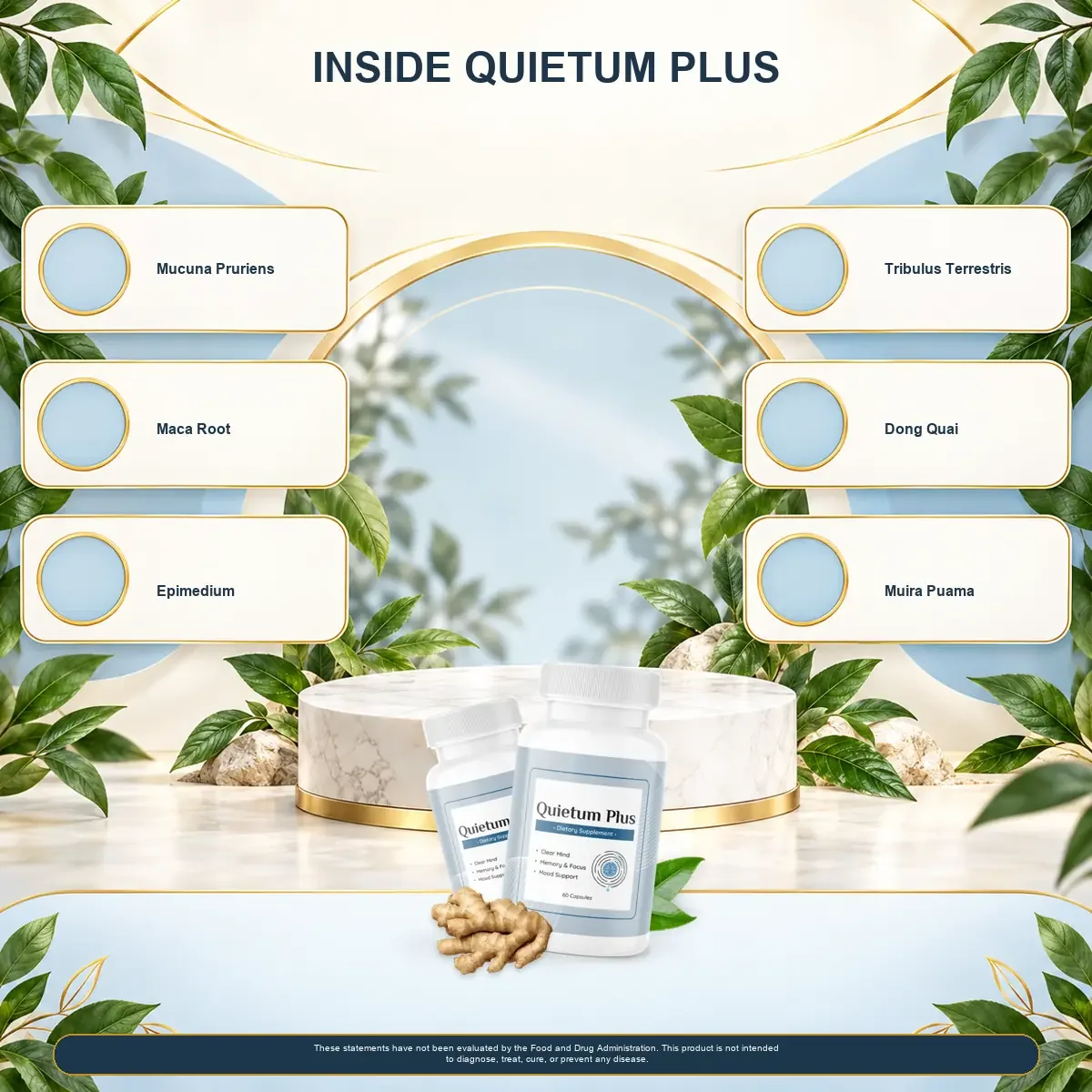
Quietum Plus fits the pattern. The bottle front reads "Clear Mind", "Memory & Focus" and "Mood Support" and says nothing about ears. The sales page adds "Specially created to support a healthy hearing" (Quietum Plus sales page). Most of its 18 listed ingredients are herbs sold for libido and energy, not for hearing.
03Trials
Which nutrients have been studied for tinnitus?
Ginkgo and zinc have the clearest reviews, and both came up short. Melatonin and B vitamins have less direct evidence.
The best evidence comes from Cochrane, an independent group that pools randomized trials. Its ginkgo review covered 12 trials and 1,915 people and found little or no effect on tinnitus scores, with very low certainty (Cochrane, Ginkgo for Tinnitus). Its zinc review covered 3 trials and 209 adults and found no evidence that oral zinc helps (Cochrane, Zinc for Tinnitus).
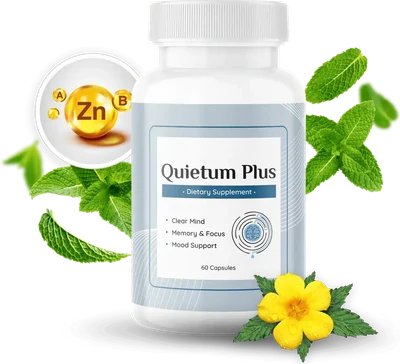
Ginkgo is not in Quietum Plus. Zinc is, with no amount printed. B vitamins are listed as "Vitamin B", with no type or amount. The table puts each study next to what the formula lists.
| Supplement | In Quietum Plus? | What the research found |
|---|---|---|
| Ginkgo biloba | Not in the list | 12 trials, 1,915 people: little to no effect on tinnitus scores; very low certainty (Cochrane, Ginkgo for Tinnitus) |
| Zinc | In the list, amount not printed | 3 trials, 209 adults: no evidence that oral zinc improves tinnitus (Cochrane, Zinc for Tinnitus) |
| Melatonin | Not in the list | The 2014 US tinnitus guideline recommended against it for persistent tinnitus (AAO-HNSF Tinnitus Guideline 2014) |
| B vitamins | "Vitamin B", type and amount not printed | No tinnitus trial in our sources; in healthy adults over 40, B vitamins had little or no effect on thinking (Cochrane, Vitamins and Minerals for Cognition) |
| Herbs in this formula | All 13 herbs, amounts not printed | No tinnitus or hearing trials found for mucuna, maca, epimedium, tribulus, dong quai, muira puama, ginger, catuaba, damiana, ashwagandha, sarsaparilla or asparagus (Brunetti et al., Herbal Sexual Enhancers) |
| Any dietary supplement | Applies to the whole product | The 2026 US guideline update: clinicians should not recommend supplements for persistent, bothersome tinnitus (AAO-HNSF Tinnitus Update 2026) (NIDCD, Tinnitus) |
The table lists what was tested, not what Quietum Plus does. No trial has tested Quietum Plus.
04Guidelines
Do any supplements have strong evidence for tinnitus?
No. The 2026 US guideline says clinicians should not recommend dietary supplements for persistent, bothersome tinnitus.
The 2026 update of the American Academy of Otolaryngology guideline sets that out in key action statement 13 (AAO-HNSF Tinnitus Update 2026). It favors a hearing evaluation, cognitive behavioral therapy and, when hearing loss is present, a hearing aid check.
The 2014 version reached the same view on supplements and named ginkgo, melatonin and zinc (AAO-HNSF Tinnitus Guideline 2014). It also advised an audiology exam when tinnitus is one-sided, lasting or tied to hearing trouble.
A hearing exam, counseling or CBT, sound support, and a hearing aid when hearing loss is found. A supplement is not on that list.
05Label check
How do I read a hearing supplement label?
Look for the serving, the amounts, the other ingredients, the warnings, the maker and the lot. If any is missing, ask before you buy.
A real Supplement Facts panel lists a serving size, servings per bottle and an amount for each ingredient. A blend may show only a total. Makers must follow manufacturing rules that include identity testing of ingredients (21 CFR Part 111, Supplement GMP), but a label alone does not prove it.
For Quietum Plus, the bottle front and the sales page print none of those details. The 18 ingredients are named, and every amount is "not printed".
- Serving size
How many capsules make one serving, and how often
Not printed in our images - Supplement Facts amounts
An amount for each ingredient, or a proprietary blend total
Not printed anywhere we could read - Other ingredients
Capsule shell (gelatin or plant cellulose), fillers, flow agents
Not printed - Warnings and allergens
Pregnancy, medicine and allergy statements
Not in our images - Directions
When and how to take it, with or without food
The page says only “Easy To Use” - Lot and best-before
Usually on the base or the neck of the bottle
Not in our images; seller reference QUI-26/GO-4530 - Maker or distributor
A company name and address are required on the label
Not named on the sales page - Seal
An intact seal under the cap
Check before the first capsule
These are the parts of a supplement label that our images and the sales page do not show. Read them on your own bottle; if one is missing or unclear, call the order desk at +1 (302) 200-3480 before you take it, and show the bottle to your doctor (Quietum Plus sales page, claims).
Quietum Plus: from $49 a bottle60 capsules a bottle · 2, 3 or 6 bottles · 60-day money-back guarantee
See packs06Ad red flags
What red flags should I watch for in ear health supplement ads?
A discovered "root cause", a promise of repair, vague science, countdown urgency and reviews you cannot check.
The Federal Trade Commission says health claims generally need randomized, controlled human testing, and that testimonials alone do not prove an effect (FTC, Health Products Compliance Guidance). Use that bar on every ad.
A single secret cause
The Quietum Plus page says "Scientists Discover The Real Root Cause of Ear Ringing". Tinnitus has many causes, and Mayo lists more than 200 conditions behind it (Mayo Clinic, Tinnitus).
Repair language
The page says the solution is to "feed, regenerate and rebuild it". No supplement has been shown to repair hearing.
Unlinked science
"Supported by several dozen studies" is not a citation. Ask for the paper, the people studied and the result.
Unverifiable reviews
The page says "based on 11,388 reviews!" with no source. Fake reviews are banned in ads (FTC, Fake Reviews Final Rule).
Also watch for a facility described as approved by the FDA. The FDA registers food facilities but does not approve them (FDA, Food Facility Registration Q&A).
07Rules
Are hearing supplements regulated?
Yes, but lightly. The FDA does not approve supplements before they are sold, and the FTC polices the ads.
The FDA is not authorized to approve dietary supplements for safety or effectiveness before sale, and many firms can market one without telling the agency (FDA, Information for Consumers on Supplements). Makers are responsible for safe products and truthful labels. The FDA can act after a problem appears.
Manufacturing rules exist (21 CFR Part 111, Supplement GMP), and the FTC can act on false ads. Neither is a substitute for a trial. A hearing supplement can be legal and untested at once.
08Next steps
What should I do before I try a hearing supplement?
Get the ringing checked, read the bottle, tell your doctor and keep every prescribed medicine going.
Start with a hearing test. About 9 in 10 people with tinnitus have noise-related hearing loss (Mayo Clinic, Tinnitus), and finding it opens real options. Then read the bottle and bring it to your clinician.
When ringing is a doctor question, not a supplement question
Sudden hearing loss in one ear (same day), ringing that beats with your pulse, ringing after a head injury, or ringing with dizziness, weakness or a drooping face. Call 911 for sudden weakness or a drooping face. Sources: NIDCD on sudden deafness (NIDCD, Sudden Deafness), the NHS (NHS, Tinnitus), Mayo Clinic (Mayo Clinic, Tinnitus) and the tinnitus guideline (AAO-HNSF Tinnitus Guideline 2014).
Never swap a prescribed medicine for a supplement. For the interaction details, read supplements and medicines. For the capsule itself, see the ingredients page and the guides hub.
09FAQ
Tinnitus supplement questions
What is a tinnitus supplement?
A tinnitus supplement is a vitamin, mineral, herb or amino acid product sold to ease ringing in the ears. No tinnitus supplement has good trial support. The NIDCD says supplements advertised for tinnitus have not been shown effective, and no FDA-approved drug exists for it (NIDCD, Tinnitus).
What are hearing supplements?
They are dietary supplements marketed for hearing, the inner ear or ear comfort. The names "hearing supplement" and "ear health supplement" are marketing terms. Legally they are supplements, which cannot claim to treat disease and are not approved by the FDA before sale (FDA, Information for Consumers on Supplements).
Which nutrients have been studied for tinnitus?
Mainly ginkgo and zinc. A Cochrane review of 12 ginkgo trials found little or no effect (Cochrane, Ginkgo for Tinnitus), and a review of 3 zinc trials found no evidence of benefit (Cochrane, Zinc for Tinnitus). Melatonin was advised against in the 2014 guideline (AAO-HNSF Tinnitus Guideline 2014).
Do any supplements have strong evidence for tinnitus?
No. The 2026 US guideline says clinicians should not recommend dietary supplements for persistent, bothersome tinnitus (AAO-HNSF Tinnitus Update 2026). Treatments with support include a hearing exam, cognitive behavioral therapy and, when there is hearing loss, hearing aids.
How do I read a hearing supplement label?
Find the serving size, servings per bottle, an amount for each ingredient, other ingredients, warnings, maker and lot. If any is missing, ask the seller first. Quietum Plus prints none of the amounts in the materials we reviewed, so read your own bottle.
What red flags should I watch for in ear health supplement ads?
Watch for a single secret cause, promises of repair, "studies" with no citations, reviews you cannot verify and countdown pressure. FTC guidance says testimonials alone do not substantiate a health claim (FTC, Health Products Compliance Guidance).
Are hearing supplements regulated?
Lightly. The FDA does not approve supplements for safety or effectiveness before they are sold, but it can act on unsafe products afterward (FDA, Information for Consumers on Supplements). The FTC polices advertising claims. Neither agency tests whether a supplement helps ringing.
10Who wrote this
Written and reviewed by
Pages built from the bottle images, the sales page and linked NIH, NIDCD, FDA, FTC and peer-reviewed sources.
Last updated . Read our editorial standards and how we check reviews. This website is run by Goquietumplus, a USA Authorized Quietum Plus Retailer, not by the manufacturer. We earn money when you buy through our order links.
Keep reading
More about Quietum Plus
USA Authorized Quietum Plus Retailer
Ready to try Quietum Plus?
Read the label, check your medicines with your doctor, then pick a pack. Bigger packs cost less per bottle, and the 60-day guarantee covers every pack.
- Secure BuyGoods checkout
- 60-day money-back guarantee
- Ships from the U.S.